November 5, 7:30 PM
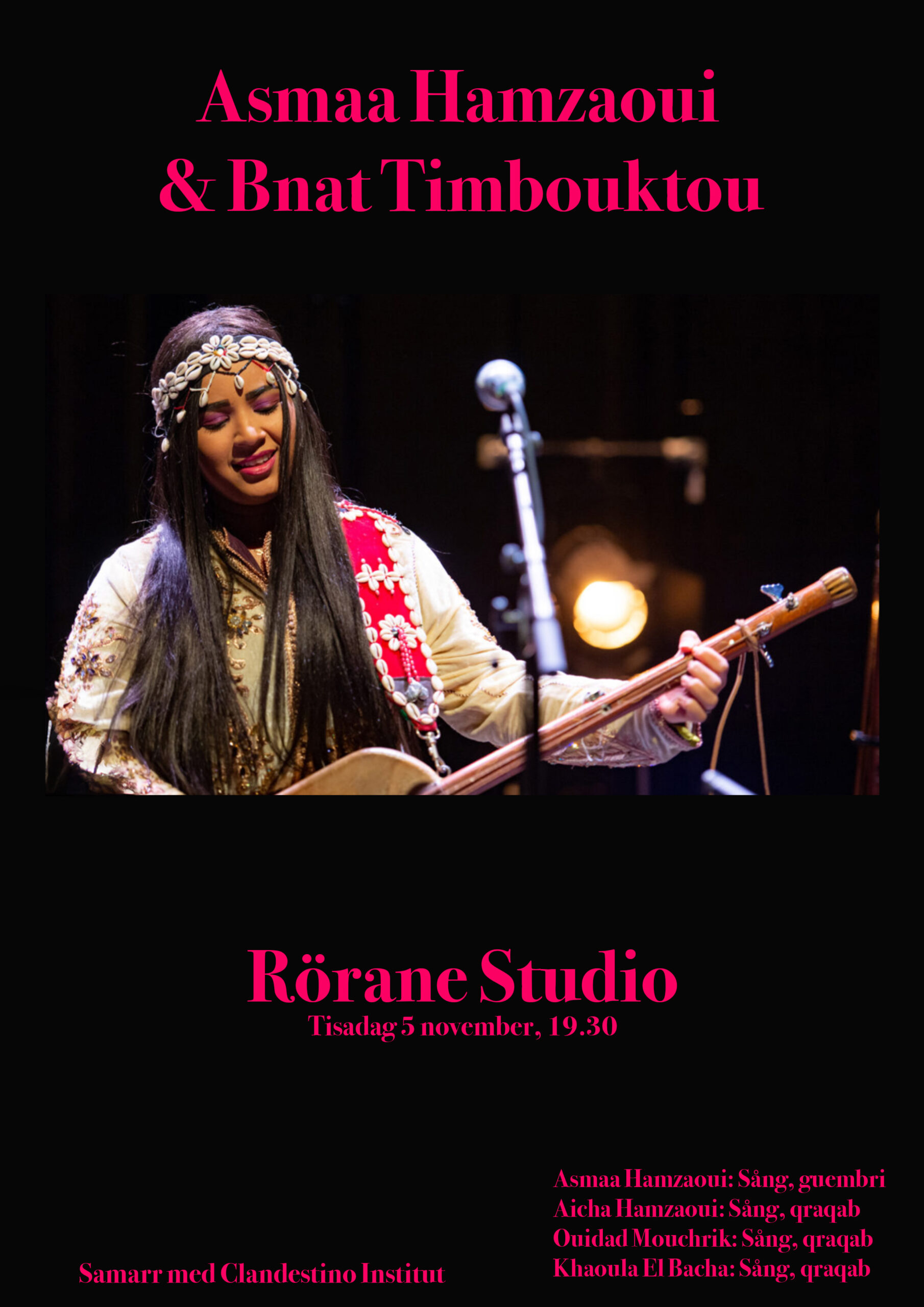
Asmaa Hamzaoui & Bnat Timbouktou
The roots of Gnawa music stretch back centuries, when it emerged as a bearer of rites and stories of suffering and slavery in northwest Africa. Traditionally, it is a musical world reserved for men, but in recent years a lot has happened both in how the genre has opened up to encounters with electronic sounds, but also in how female bandleaders have established themselves. The main example today (alongside Bab L’Bluz) is Asmâa Hamzaoui. Hamzaoui grew up in Casablanca, and with a father who was a top-level Gnawa musician and a mother who was a dancer, she learned to play and sing at an early age. First as a background singer in various groups, but soon also with her own band, Bnat Timboktou, which consists exclusively of female musicians.
The backbone of the music is Asmâa Hamzaoui’s guembri. Muffled riffs move freely from the Moroccan bassline and dance over a repetitive accompaniment of qraqeb, metal castanets. Asmâa Hamzaoui’s powerful voice extends over the intense mesmeristic rhythms and immediately receives responses from the rest of the members, in an almost gospel-like call and response.
After starting a collaboration with the Swedish record label Ajabu! Records, Asmaa Hamzaoui & Bnat Timbouktou recorded their debut album Oulad Lghaba in Casablanca and Stockholm. The album was nominated for the Songlines Music Award, and was followed by L’Bnat, released in 2024.
Asmâa Hamzaoui & Bnat Timbouktou
The roots of Gnawa music stretch back centuries, when it emerged as the bearer of rites and stories about the suffering of slavery in north-west Africa. Traditionally, this is a music genre reserved for men, but in recent years much has happened both in how the tradition has been married to electronic sounds, but also in how female band leaders have emerged. The most prominent example is probably Asmâa Hamzaoui. Hamzaoui grew up in Casablanca, and with her father being a top class Gnawa musician, she quickly learned to play and sing. First as a backing member of various groups, but soon with her own all female band, Bnat Timboktou.
Asmaa Hamzaoui’s guembri playing is at the center of her music. Deep riffs move freely from this Moroccan bass lute and dance over repetitive rhythms of metal castanets called qraqeb. Asmâa Hamzaoui’s powerful voice reaches out over the dense mesmerizing wall of percussion, and is immediately answered by the rest of the members, in an almost gospel-like call and response.
After initiating a collaboration with Swedish label Ajabu! Records, Asmâa Hamzaoui & Bnat Timbouktou recorded their debut album Oulad Lghaba in Casablanca and Stockholm. The album was nominated for a Songlines Music Award, and was followed by L’Bnat, released in 2024.
Asmaa Hamzaoui: Vocals, guembri
Aicha Hamzaoui: Vocals, qraqab
Ouidad Mouchrik: Vocals, qraqab
Khaoula El Bacha: Vocals, qraqab
After a break, Los Gaiteros de San Jacinto take the stage, Colombia’s premier cumbia and gaita music ensemble. Gaita is the name of a genre but also of the instrument that plays the lead role; a cactus and beeswax flute, whose soft tone is played with a strong vibrato. Often several parts are heard accompanied by drums and shakers.
The gaita’s status is iconic in Colombian music, and it is something of a symbol of the country’s history. Before colonial times, the instrument played an important role for the indigenous people, who called the flute Chuana and Chuarras. The Spaniards instead renamed it gaita, as the tone reminded them of the sound of the Galician bagpipe of the same name.
The first edition of Gaiteros de San Jacinto was started by Miguel Antonio “Toño” Fernández, and since then, members have passed on to the next generation to carry on the legendary band. Today, they are a tight sextet led by singer Rafael Castro.
On the album Un Fuego de Sangre Pura, released as part of the Smithsonian Folkways Recordings series, they depicted the poverty and suffering of their home region of Montes de María near Colombia’s Caribbean coast. The record won a Latin Grammy in 2007 and for the first time, the gaita, along with the group’s own life stories, reached far beyond the South American continent. This year they are relevant with the album Orgullo Colombiano where Los Gaiteros de San Jacinto show in twelve songs that they are equally rooted in both the colorful history of cumbia and gaita, and in the genre’s contemporary metamorphoses.
Organized together with Clandestino Institut
Book a place at studio@rorane.se